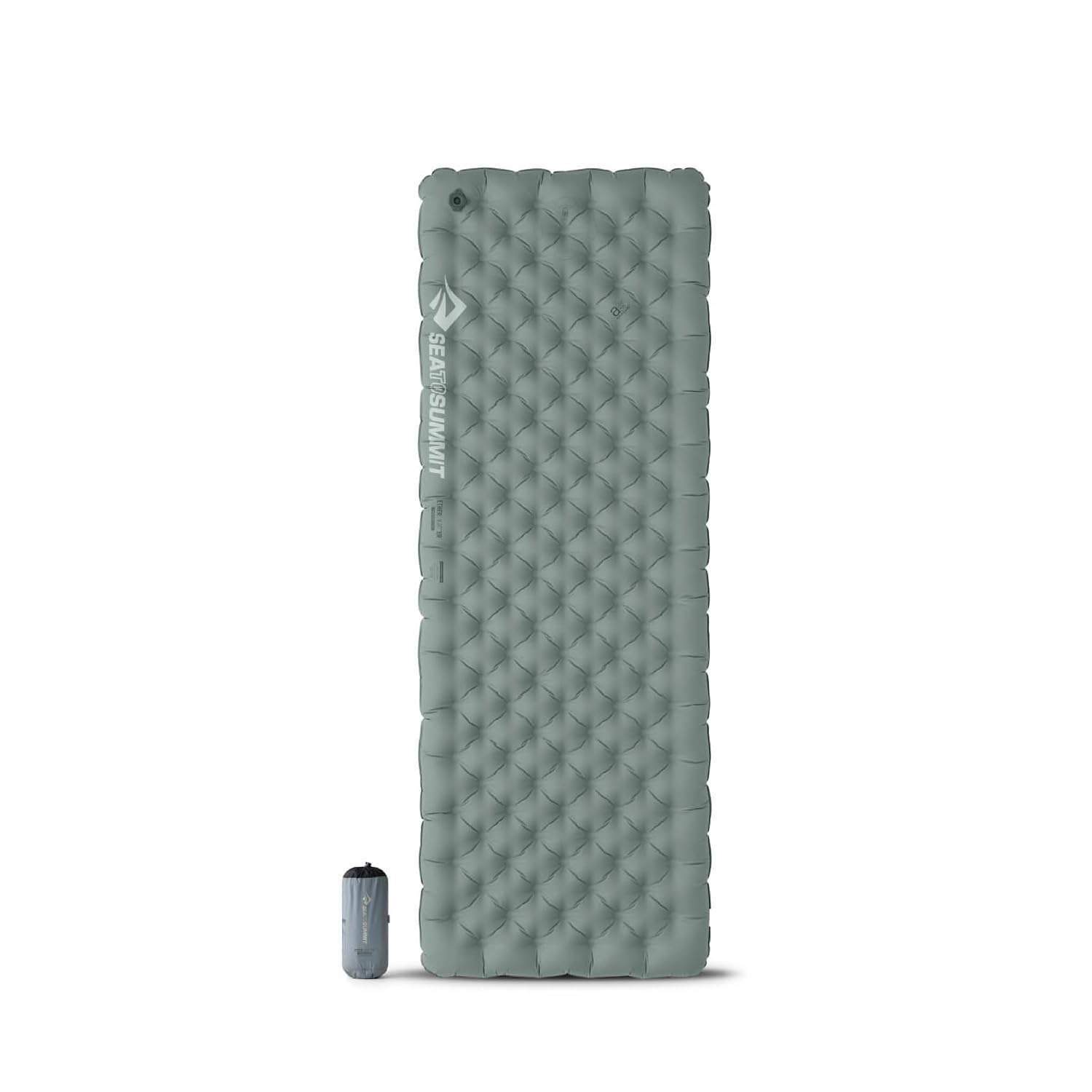
 Product photoSea to Summit Ether Light XR
A thick, cushioned sleeping pad for side sleepers and campers who prioritize pressure relief. This long-form profile explains where the model fits, what to verify, and which trade-offs deserve attention before you buy.
The Sea to Summit Ether Light XR is a thick, cushioned sleeping pad for side sleepers and campers who prioritize pressure relief. Its 4-inch air-sprung cushion and ThermalCore reflective insulation keep hips and shoulders off the ground on uneven campsites, while the rectangular shape gives real sleeping room. It is not the lightest pad or a firm, low-profile mat, so check the size and packed dimensions before buying.
Affiliate disclosure: some retailer links may earn a commission. That does not change the evidence labels or the need to verify the exact product, variant, current price, availability, warranty, and returns.
- Thick air-sprung construction
- Side-sleeper-friendly cushion
- Compact packed size
- 4 in / 10 cm cushion on current XR listing
- ThermalCore reflective insulation on current listing
- Rectangular regular variant observed
What retailer reviews can and cannot tell you
The Amazon result was a related or newer variant, so this profile does not treat its rating as evidence for the exact model.
Retailer evidence captured on 13 November 2026. Ratings and review themes can change and are not firsthand testing.
A thick pad for people who feel the ground
Some sleepers feel every root and rock through a thin pad, and for them, thickness is the feature that matters most. The Ether Light XR's 4-inch cushion on the current listing gives hips and shoulders room to sink without touching the ground, which is the difference between sleeping and merely lying awake. Side sleepers benefit most, since the hip and shoulder take the body's weight on a small area.
Thickness also forgives imperfect campsites. A pad this thick smooths out lumps, roots, and slopes that would be miserable on a thin mat, which means you spend less time searching for the perfect pitch and more time sleeping. If your trips take you to rough or uneven ground, a thick pad is the simplest comfort upgrade you can make.
Air-sprung cells and pressure relief
The Ether Light XR uses air-sprung cells, small interconnected air pockets that distribute pressure across the pad's surface. Instead of a single air chamber that pushes back uniformly, the cells let your body settle into the pad while supporting the heavier points. The result feels more like a mattress than an airbed, which is why side sleepers and restless sleepers notice the difference immediately.
Pressure relief matters because a pad that pushes back too hard creates numbness and restlessness. A pad that distributes pressure lets you stay in one position longer, which means deeper sleep and fewer wake-ups. If you have ever woken with a dead arm on a camping trip, you know exactly what this feature addresses.
ThermalCore insulation and cold-ground nights
The ThermalCore reflective insulation on the current listing reflects body heat back toward the sleeper instead of letting it escape into the ground. That matters because the ground is the main source of heat loss at night: even on a mild evening, the earth is cooler than your body, and an uninsulated pad lets that temperature difference drain your warmth all night.
Insulation extends your camping season and improves your sleep on every trip, not just the cold ones. A warm pad means you can use a lighter sleeping bag, or sleep comfortably in a bag that would otherwise feel marginal. Check the insulation details and R-value on the listing for the exact size and version you are buying, since these figures can vary.
The rectangular shape and sleeping room
The rectangular regular variant gives you the same width at the feet as at the shoulders, which suits sleepers who move around, sprawl, or share the tent with gear at their feet. A mummy-shaped pad saves weight and pack space, but it narrows at the feet, which can feel restrictive if you sleep on your back with your feet apart or toss and turn.
Rectangular pads also pair better with rectangular sleeping bags and quilts, since the edges line up and there is no wasted space. If you sleep in a quilt or a roomy bag, the rectangular shape makes the whole sleep system feel more coherent. The trade is packed size and weight, since a rectangular pad uses more material than a mummy pad of the same length.
Inflation, firmness, and finding your setting
Inflating the Ether Light XR is straightforward, and the valve is designed for quick inflation and deflation. The key is finding your firmness: a pad inflated rock-hard feels like a board and pushes back against your hips, while a pad with a little give lets your body settle into the air-sprung cells. Most sleepers find the sweet spot slightly softer than maximum firmness.
Experiment at home before your first trip. Inflate the pad fully, lie on it, then release a little air at a time until your hips just stop touching the ground. Note how many breaths or pump strokes that takes, and you will be able to reproduce it at camp without trial and error in the dark.
How it compares: Ether Light XR vs Tensor Trail vs a foam pad
Against the NEMO Tensor Trail, the Ether Light XR is the thicker, softer pad. The Tensor Trail is quieter and more focused on insulation and packability, while the Ether Light XR prioritizes cushion and pressure relief. Side sleepers who want maximum softness usually prefer the Ether Light, and cold sleepers who want quiet insulation usually prefer the Tensor Trail.
Against a closed-cell foam pad, the Ether Light XR is far more comfortable and packable, but it can puncture and needs inflation. Foam pads are indestructible and cheap, and they make a good backup or winter layer underneath an inflatable pad. For sleep quality alone, the inflatable pad wins by a wide margin.
Who should choose a different pad
Skip the Ether Light XR if you need the lightest possible pad, since thickness and cushion add weight that an ultralight pad avoids. Skip it if you prefer a firm, low-profile feel, since this pad is designed to be soft and deep. And skip it if you only camp in warm weather on smooth ground, where a thinner pad would be adequate and lighter.
Also consider a different pad if your pack space is very tight, since a thick rectangular pad packs larger than a mummy-shaped ultralight pad. Check the packed dimensions against your pack before buying, and be honest about how much room you actually have.
A practical decision table
| Decision point | What to verify | Why it matters |
|---|---|---|
| Role | A thick, cushioned sleeping pad for side sleepers and campers who prioritize pressure relief. | Thick cushion gives side sleepers real pressure relief |
| Fit and access | Side sleepers who dislike feeling the ground and want a softer camp sleep surface. | Air-sprung cells suit restless and side sleepers |
| Limit | You need the lightest possible pad or prefer a firm, low-profile feel. | Weight and softness rule out ultralight buyers |
| Evidence | 4 in / 10 cm cushion on the XT family | Cushion and insulation vary by listing |
Frequently asked questions
Is the Ether Light XR good for side sleepers?
Yes. The 4-inch cushion and air-sprung cells are designed for side sleepers, whose hips and shoulders need extra depth to avoid touching the ground. A thick pad with pressure relief makes the biggest difference for side sleepers.
What are air-sprung cells?
They are small interconnected air pockets that distribute pressure across the pad's surface. Instead of a single air chamber pushing back uniformly, the cells let your body settle in while supporting the heavier points, which feels more like a mattress.
How warm is the Ether Light XR?
The ThermalCore reflective insulation reflects body heat back toward the sleeper, which helps on cold ground. Check the R-value on the listing for the exact size and version, since insulation figures can vary.
How does it compare to the NEMO Tensor Trail?
The Ether Light XR is thicker and softer, which suits side sleepers who want maximum cushion. The Tensor Trail is quieter and more focused on insulation and packability. Choose cushion first for the Ether Light, and warmth and quietness for the Tensor Trail.
How firm should I inflate it?
Slightly softer than maximum firmness usually works best. Inflate fully, lie on it, then release air until your hips just stop touching the ground. Experiment at home so you can reproduce the setting at camp.
Can it puncture, and what do I do if it does?
Any inflatable pad can puncture on sharp ground. Clear the campsite before pitching, and carry a small repair kit. Most punctures are easy to find and patch in the field with the included repair supplies.
Useful Sources and Verification
Use these source types to verify current details before buying or publishing a recommendation.
- The current manufacturer product page and technical documentation for Sea to Summit Ether Light XR
- The exact retailer listing checked for the model, variant, included components, and commercial terms
- Independent review patterns treated as context rather than a substitute for personal fit or field testing
- Sea to Summit official website for the current product page and technical documentation