
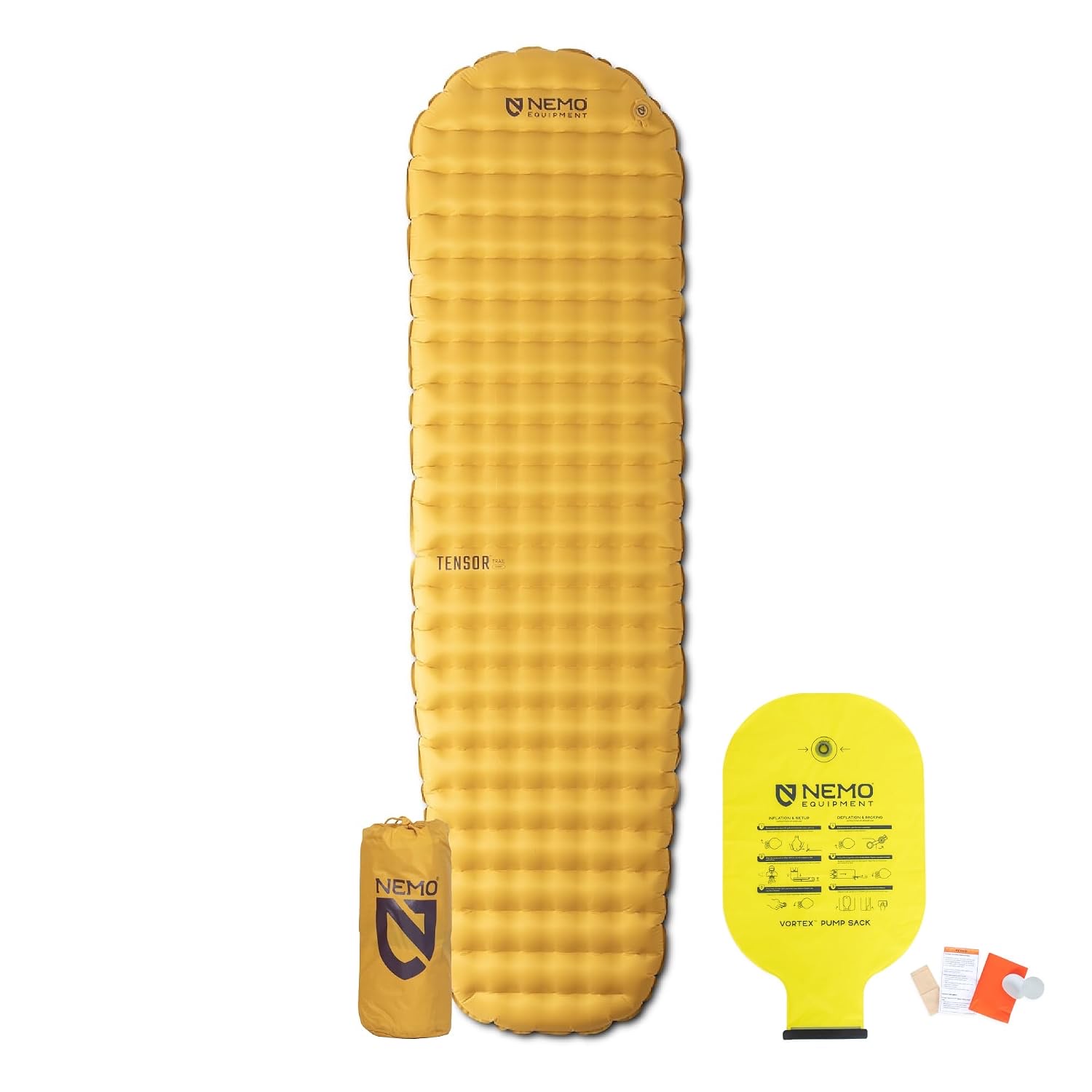
 Product photoNEMO Tensor Trail
An insulated sleeping pad for hikers who care about quiet comfort and warmth across more than one season. This long-form profile explains where the model fits, what to verify, and which trade-offs deserve attention before you buy.
The NEMO Tensor Trail is an insulated sleeping pad for hikers who care about quiet comfort and warmth across more than one season. Its insulated inflatable construction cushions the body on uneven ground and keeps the cold out, while the packable shape fits easily into a backpack. It is not a warm-weather-only pad or a cheap foam mat, so check the size, R-value, and valve details on the listing before buying.
Affiliate disclosure: some retailer links may earn a commission. That does not change the evidence labels or the need to verify the exact product, variant, current price, availability, warranty, and returns.
- Insulated inflatable construction
- Comfort-focused thickness
- Packable shape for backpacking
- Insulated inflatable pad
- Regular mummy variant observed
- Current R-value and dimensions vary by size/version
What retailer reviews can and cannot tell you
The Amazon result was a related or newer variant, so this profile does not treat its rating as evidence for the exact model.
Retailer evidence captured on 13 November 2026. Ratings and review themes can change and are not firsthand testing.
Why an insulated pad changes your sleep
A sleeping pad has two jobs: cushion and insulation. The cushion keeps your hips and shoulders off the ground, and the insulation stops the cold ground from stealing your body heat all night. Many hikers learn this the hard way, buying a warm sleeping bag and then shivering on a thin uninsulated pad. The Tensor Trail addresses both jobs in one piece of gear.
Insulation matters across more than one season because ground temperature changes far less than air temperature. Even on a mild autumn night, the ground can be cold enough to drain warmth from a sleeper on an uninsulated pad. An insulated pad extends your camping season and improves your sleep on every trip, not just the cold ones.
Quiet comfort: why noise matters at 2 a.m.
Some inflatable pads crinkle loudly every time you roll over, and that noise keeps both you and your tentmate awake. The Tensor Trail is designed to be quieter, which matters more than it sounds: a pad you can shift on without waking yourself is a pad you will actually sleep on. If you are a restless sleeper or you share a tent, quietness is a genuine feature, not a luxury.
Comfort also comes from the pad's thickness and internal structure. A thicker pad with a stable surface keeps your hips off the ground when you sleep on your side, and the mummy shape saves weight and pack space without cutting the width where your shoulders need it. Side sleepers and cold sleepers benefit most from this design.
Warmth: reading the R-value honestly
The R-value measures how well a pad resists heat loss to the ground, and higher numbers mean more insulation. The Tensor Trail's current R-value and dimensions vary by size and version, so confirm the exact figure on the listing for the size you are buying. A pad's R-value is only meaningful when you know which size and version it applies to.
Use the R-value as a comparison tool, not a guarantee. Your sleeping bag, the ground temperature, and whether you sleep warm or cold all affect the result. As a rough guide, a pad with meaningful insulation covers three-season use, while winter camping needs a higher-rated pad or a foam pad layered underneath. If you sleep cold, choose more insulation than the minimum.
Inflation, valves, and the bedtime routine
Inflating a pad at the end of a long day should take minutes, not a lung-busting effort. The Tensor Trail's valve design is meant to make inflation and deflation straightforward, and a pump sack or a few breaths will get it firm. The right firmness is personal: a pad inflated rock-hard feels like a board, while a slightly softer pad lets your hips sink just enough to stay comfortable.
Deflation and packing matter just as much. A pad that folds and rolls easily, without trapping air in the corners, saves time and frustration in the morning. Practice the fold at home once, and store the pad unrolled with the valve open between trips so the insulation keeps its loft.
Packed size and the weight question
An insulated inflatable pad packs far smaller than a foam pad of similar warmth, which is why it is the standard choice for backpackers. The Tensor Trail's packable shape fits into a pack's main compartment or a side pocket without dominating the load, and the weight is reasonable for the insulation it provides. Compare the packed size against your pack's remaining space, not against other pads in isolation.
The weight trade is honest: insulation and cushion add grams, and a lighter pad would be thinner or uninsulated. If your trips are short and warm, a lighter pad may be enough. If you camp across seasons or sleep cold, the Tensor Trail's insulation earns its weight on every night you use it.
How it compares: Tensor Trail vs Ether Light XR vs a foam pad
The Sea to Summit Ether Light XR takes the opposite approach, trading a quieter night for a deeper, softer mattress feel. Where the Tensor Trail keeps noise and packed size down, the Ether Light XR piles on cushion, which side sleepers tend to love. If your priority is falling asleep quickly on a quiet pad, the Tensor Trail is the better fit; if it is sinking into a soft surface, look at the Ether Light XR.
Against a closed-cell foam pad, the Tensor Trail is far more comfortable and packable, but it can puncture and needs inflation. Foam pads are indestructible, cheap, and useful as a backup or a sit pad, but they cannot match an inflatable pad for sleep quality. Many experienced hikers carry both on winter trips, using the foam pad underneath for extra insulation.
Who should choose a different pad
Skip the Tensor Trail if you only camp in warm weather, since an uninsulated pad would be lighter and cheaper for summer-only use. Skip it if you need the cheapest possible option, since a foam pad costs far less and cannot puncture. And skip it if you are a very restless sleeper who needs maximum thickness, since a thicker pad like the Ether Light XR may suit you better.
Also consider a different pad if you camp in winter, where a higher R-value or a layered foam-plus-inflatable system is the safer choice. An insulated three-season pad is not a winter pad, and the difference shows up at 3 a.m. when the ground is coldest.
A practical decision table
| Decision point | What to verify | Why it matters |
|---|---|---|
| Role | An insulated sleeping pad for hikers who care about quiet comfort and warmth across more than one season. | Insulation and cushion decide sleep quality |
| Fit and access | Backpackers who sleep cold or want a quieter, more cushioned night on uneven ground. | Quietness and thickness suit cold and side sleepers |
| Limit | You only camp in warm weather or need the cheapest thin foam pad. | Warmth and price rule out summer-only buyers |
| Evidence | 5.4 R-value | R-value and size vary, so verify the listing |
Frequently asked questions
What does the R-value mean on a sleeping pad?
The R-value measures how well the pad resists heat loss to the ground. Higher numbers mean more insulation. The Tensor Trail's R-value varies by size and version, so confirm the exact figure on the listing for the size you are buying.
Is the Tensor Trail quiet to sleep on?
Yes, it is designed to be quieter than many inflatable pads, which matters if you roll over at night or share a tent. A quiet pad lets you shift position without waking yourself or your tentmate.
Can I use the Tensor Trail in winter?
It is designed for multi-season use, but deep winter camping usually needs more insulation. For winter, consider a higher R-value pad or layer a foam pad underneath the Tensor Trail for extra ground insulation.
How do I inflate the Tensor Trail?
Use the valve with a pump sack or a few breaths until the pad feels firm but not board-hard. A slightly softer pad is often more comfortable, since it lets your hips sink just enough. Practice inflation at home before your first trip.
How does it compare to the Sea to Summit Ether Light XR?
The Ether Light XR is built around a deep, soft mattress feel, while the Tensor Trail is built around quiet insulation in a smaller package. Side sleepers chasing softness often pick the Ether Light, and cold sleepers chasing quiet warmth often pick the Tensor Trail.
How should I store an inflatable pad?
Store it unrolled with the valve open, in a dry place. Storing it compressed for months can reduce the insulation's loft. Rinse off dirt after trips and let it dry fully before storage.
Useful Sources and Verification
Use these source types to verify current details before buying or publishing a recommendation.
- The current manufacturer product page and technical documentation for NEMO Tensor Trail
- The exact retailer listing checked for the model, variant, included components, and commercial terms
- Independent review patterns treated as context rather than a substitute for personal fit or field testing
- NEMO official website for the current product page and technical documentation