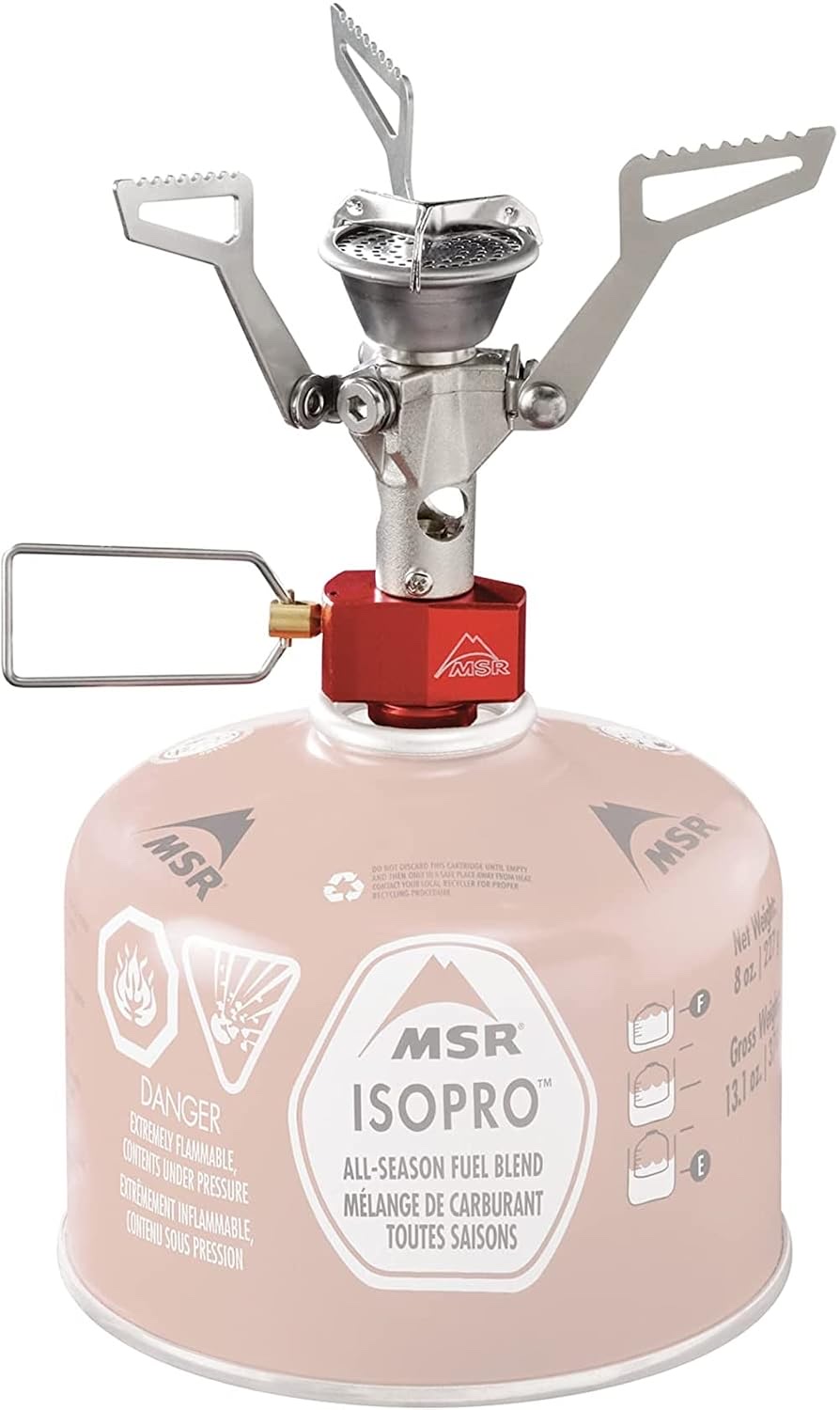
 Product photoMSR PocketRocket 2
A compact canister-top stove for backpackers who want fast boils and a tiny packed size on multi-day trips. This long-form profile explains where the model fits, what to verify, and which trade-offs deserve attention before you buy.
The MSR PocketRocket 2 is a compact canister-top stove for backpackers who want fast boils and a tiny packed size. It screws onto a fuel canister, folds down to almost nothing, and boils water quickly for dehydrated meals, coffee, and hot drinks. It is not a gourmet cooking stove or a cold-weather expedition burner, so check the wind performance and fuel plan before buying.
Affiliate disclosure: some retailer links may earn a commission. That does not change the evidence labels or the need to verify the exact product, variant, current price, availability, warranty, and returns.
- Canister-top stove format
- Folding pot supports
- Manual ignition, no built-in piezo
- PocketRocket 2 stove family
- Compact folding design
- Fuel canister sold separately
What a PocketRocket 2 actually does at camp
The PocketRocket 2 has one job: boil water quickly, with minimal weight and bulk. It screws onto a standard fuel canister, lights with a match or lighter, and brings water to a boil in minutes. That simplicity is its strength: there is nothing to assemble, nothing to prime, and nothing to maintain beyond basic care.
For backpackers who eat dehydrated meals, drink coffee, and want a hot drink at the end of the day, a fast-boil stove is all they need. The PocketRocket 2 does that job as well as any stove on the market, and it does it in a package that fits in a pocket.
Size, weight, and the packed-size advantage
The PocketRocket 2 folds down to a tiny size, with pot supports that tuck away and a body that fits in the palm of your hand. That packed size matters on a multi-day trip, where every cubic centimetre of pack space counts. The stove disappears into a pot, a pocket, or a stuff sack, and you forget it is there until you need it.
Weight is equally minimal. A canister-top stove this small adds almost nothing to your pack, which is why it is the standard choice for weight-conscious backpackers. The trade is cooking control, since a tiny burner with a narrow flame is designed for boiling, not for simmering a complex meal.
Boil time and the wind question
Boil time depends on water temperature, altitude, wind, and pot size, so there is no single number that applies everywhere. In calm conditions with a small pot, the PocketRocket 2 boils water quickly. In wind, the exposed burner loses heat, and boil time increases noticeably. A windscreen, or a sheltered cooking spot, makes a real difference.
The practical habit is to cook in a sheltered spot, shield the stove from wind with your body or a windscreen, and use a lid on the pot to retain heat. Those three habits will boil water faster than any stove upgrade. Wind is the enemy of a small burner, and managing it is a skill worth learning.
Fuel canisters: what to carry and how much
The PocketRocket 2 runs on standard threaded fuel canisters, which are available at outdoor shops and many general stores. Canisters come in several sizes, and the right size depends on your trip length and how much cooking you do. A small canister covers a weekend of simple boiling, while a longer trip needs a larger one or a spare.
Count your boils before the trip: how many hot meals and drinks per day, and how much water each needs. Add a margin for wind and cold, which increase fuel use. Running out of fuel on the second night turns dinner into a cold snack, so carry a little more than you think you need.
Cooking beyond boiling: the honest limits
The PocketRocket 2 is a boiling stove, not a cooking stove. It excels at heating water for dehydrated meals, coffee, and soup, but it struggles with tasks that need precise heat control, such as simmering a sauce or frying. The narrow burner concentrates heat in the centre of the pot, which can scorch food that needs gentle, even heating.
If your trail cooking involves real meals with multiple steps, a wider burner with better simmer control will serve you better. If your meals are mostly boiled water plus a pouch, the PocketRocket 2 is the right tool. Match the stove to your cooking style, not to a feature list.
Cold weather and altitude: when a canister stove struggles
Canister stoves lose performance in cold weather, because the fuel pressure drops as the canister cools. Below freezing, a canister stove may struggle to produce a strong flame, and in very cold conditions it may barely work at all. Keeping the canister warm, in a pocket or sleeping bag, helps, but it does not solve the problem entirely.
Altitude also affects performance, since thinner air and lower temperatures change how the fuel burns. For winter camping and high-altitude trips, a liquid-fuel stove is the more reliable choice. The PocketRocket 2 is a three-season stove, and it should be judged as one.
Who should choose a different stove
Skip the PocketRocket 2 if you cook elaborate meals that need simmer control, since a wider burner with a better valve will serve you better. Skip it if you hike in very cold conditions, where a liquid-fuel stove is more reliable. And skip it if you want a built-in piezo igniter, since this stove needs a match or lighter.
Also consider a different stove if you cook for a group, where a larger burner and a bigger pot will serve everyone faster. The PocketRocket 2 is an individual or pair stove, and using it to cook for four people is a slow process.
A practical decision table
| Decision point | What to verify | Why it matters |
|---|---|---|
| Role | A compact canister-top stove for backpackers who want fast boils and a tiny packed size on multi-day trips. | Fast boils cover the meals most backpackers eat |
| Fit and access | Backpackers who boil water for meals and want a stove that packs tiny. | Tiny packed size suits multi-day trips |
| Limit | You cook elaborate meals, need to simmer precisely, or hike in very cold conditions. | Simmer and cold limits rule out some buyers |
| Evidence | Compact canister-top stove | Fuel and wind performance vary by conditions |
Frequently asked questions
Does the PocketRocket 2 include a fuel canister?
No. Fuel canisters are sold separately. The stove screws onto a standard threaded canister, available at outdoor shops. Choose the canister size based on your trip length and cooking needs.
How do I light the PocketRocket 2?
With a match or lighter. The stove has no built-in piezo igniter, so carry a lighter and a backup. Open the valve slightly, light the burner, then adjust the flame.
Can I use the PocketRocket 2 in winter?
Not reliably. Canister stoves lose pressure in cold weather, and below freezing the flame weakens significantly. For winter camping, a liquid-fuel stove is the more reliable choice.
How much fuel do I need for a trip?
Count your boils: hot meals and drinks per day, and how much water each needs. Add a margin for wind and cold. A small canister covers a weekend of simple boiling; longer trips need more.
Can I simmer with the PocketRocket 2?
Only roughly. The narrow burner concentrates heat, which suits boiling but not precise simmering. If you cook meals that need gentle heat, a wider burner with better control is a better choice.
How do I cook in wind with a small stove?
Cook in a sheltered spot, shield the stove with your body or a windscreen, and use a lid on the pot. Wind is the biggest factor in boil time, and managing it matters more than the stove model.
Useful Sources and Verification
Use these source types to verify current details before buying or publishing a recommendation.
- The current manufacturer product page and technical documentation for MSR PocketRocket 2
- The exact retailer listing checked for the model, variant, included components, and commercial terms
- Independent review patterns treated as context rather than a substitute for personal fit or field testing
- MSR official website for the current product page and technical documentation