
A practical guide to choose trekking poles for hiking, with a clear decision path, route-aware checks, and a repeatable plan that does not depend on a universal winner.
The best trekking poles for your hiking are the ones that match your terrain, your body, and how often you use them. Aluminum poles with lever locks suit most hikers, an extended grip helps on changing terrain, and the right length is the one that keeps your elbow near a right angle on flat ground.
Position and Plan
Position: A research-led buying guide for hikers choosing trekking poles by fit, terrain, movement, and carry needs without padding the article with unrelated gear.
Plan: Help a reader shortlist two relevant trekking-pole options, verify current listing details, and choose based on route demands rather than a universal winner.
Inline verification links: Black Diamond trekking pole guide · REI trekking pole selection guide · Black Diamond Trail Trekking Poles · LEKI Makalu Lite official product page
Affiliate disclosure: some retailer links may earn a commission. This does not change the evidence boundaries or the need to verify current product, variant, price, availability, warranty, and return details.
Why poles help: knees, balance, and rhythm
Trekking poles help in three ways: they share the load with your arms, which reduces knee strain on descents; they provide balance on uneven ground, stream crossings, and loose surfaces; and they establish a rhythm that makes long days feel easier. The benefit is largest for hikers with knee trouble, heavier loads, or steep routes.
The knee benefit is the most studied: poles let your arms absorb some of the braking force on descents, instead of leaving it all to your knees. Over a long day with a pack, that assistance adds up to noticeably less fatigue. Poles do not fix knee problems, but they reduce the load each step places on the joint.
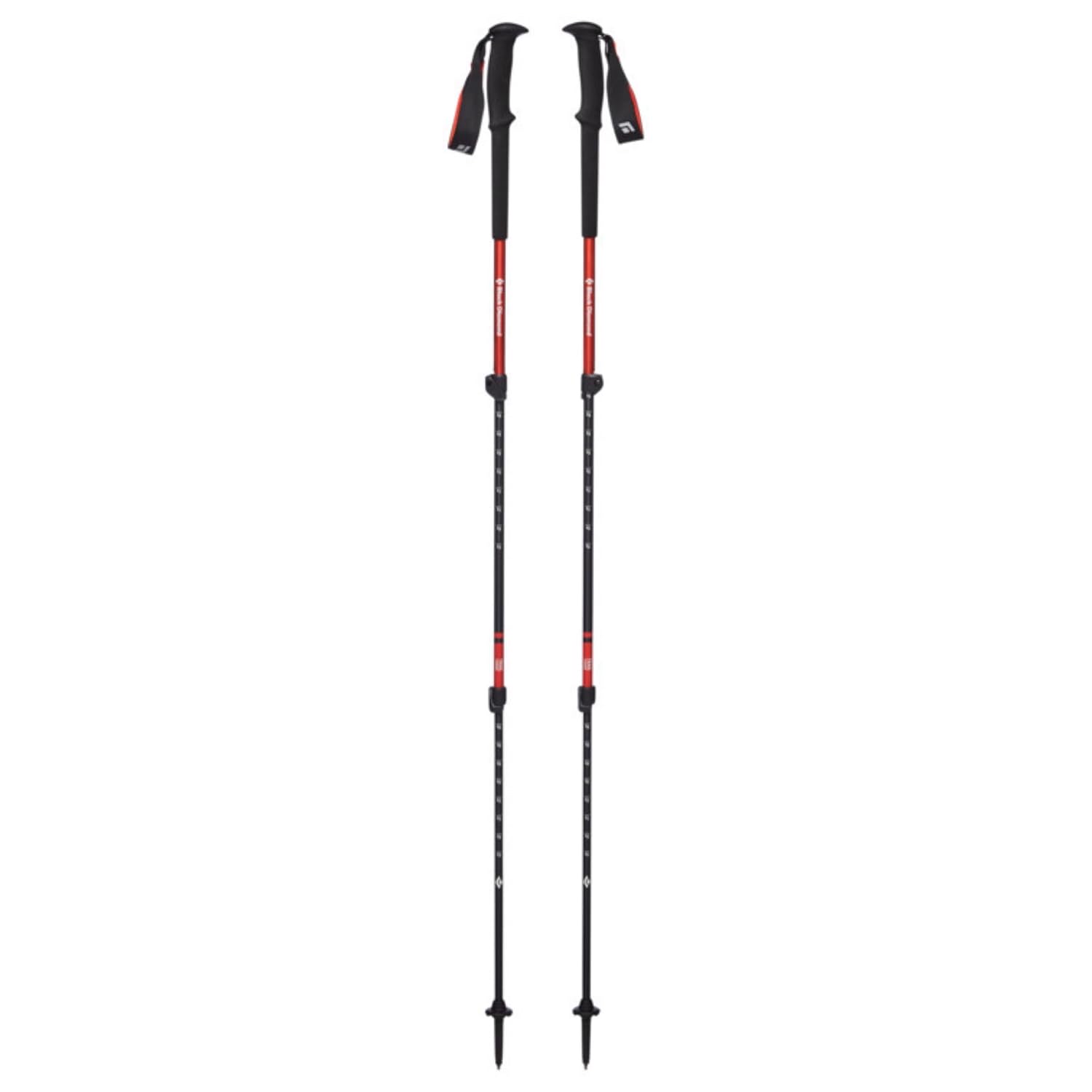
BLACK DIAMOND Trail Trekking Poles
Best for: Hikers who want a dependable two-pole setup for rocky or steep routes.
Adjustable trekking poles for stability on descents, uneven ground, and long days when your knees need help.
Why poles help: knees, balance, and rhythm
- Adjustable aluminum construction
- Comfort-focused grips
- Useful for climbs, descents, and balance
- You only need an ultralight single pole or dislike carrying poles between obstacles.
Pole materials: aluminum vs carbon
Aluminum is the standard pole material for general hiking: it bends rather than snapping, survives being wedged between rocks, and costs less than carbon. The trade is weight, since aluminum poles are heavier than carbon poles of similar strength. For most hikers, the durability and value of aluminum outweigh the weight saving of carbon.
Carbon poles save weight and reduce swing fatigue, which matters for racers, fastpackers, and very long days. The trade is fragility: carbon cracks under a sharp sideways load where aluminum would bend. For a first pair, or for rocky terrain, aluminum is the safer and cheaper choice.
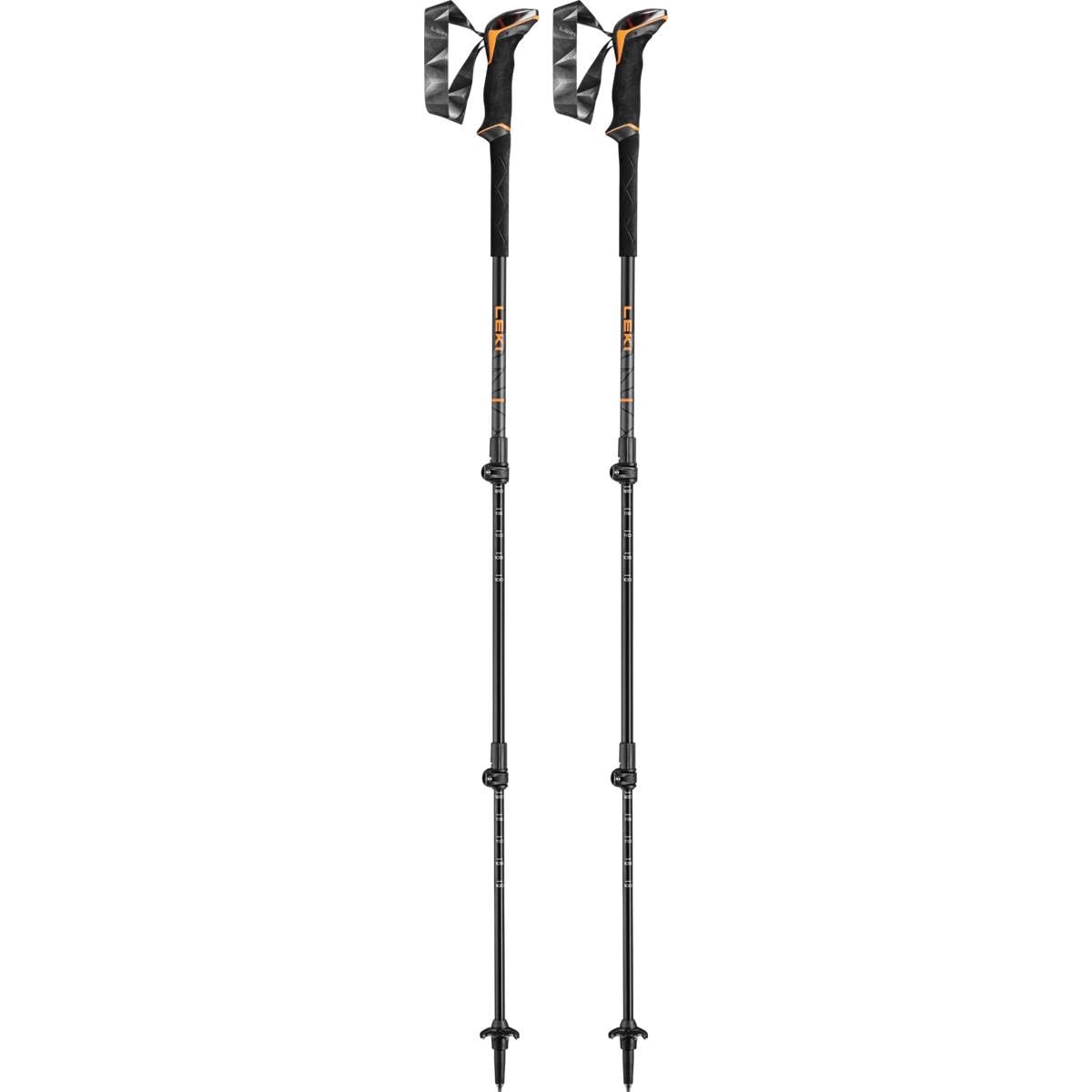
LEKI Makalu Lite
Best for: Long-distance hikers who use poles consistently and care about swing weight.
A lighter trekking-pole option for hikers who want dependable adjustment without carrying expedition-grade weight.
Pole materials: aluminum vs carbon
- Lightweight adjustable design
- Extended grip for changing hand positions
- Trail-focused durability
- You need the cheapest starter pair or a compact carbon race pole.
Locks and adjustment: lever vs twist
Lever locks clamp the pole sections with a visible mechanism you can check by eye and tighten if it loosens. Twist locks use an internal expander that tightens when you twist the sections. Lever locks are generally more reliable and easier to use with gloves, while twist locks are lighter and simpler.
Whatever lock type you choose, test it under body weight before a serious route. Plant the pole, lean on it, and confirm nothing slips. A pole that collapses under load on a descent is worse than no pole at all, since it removes support at the exact moment you are leaning on it.
Grips, straps, and hand comfort
Grip comfort decides whether poles stay in your hands all day or get strapped to the pack by lunchtime. Cork grips mould to your hand and handle sweat well, foam grips are soft and light, and rubber grips are durable but can feel harsh. The best grip is the one that feels comfortable after an hour, not just after a minute in the shop.
Wrist straps should carry some of the load so your hands do not grip hard all day. Adjust the straps so your weight rests on the strap, and you will finish the day with far less hand fatigue. An extended grip, which lets you choke down on the pole without adjusting the length, is a valuable feature on changing terrain.
Build the system around the hardest likely moment
Build around the hardest likely moment rather than the easiest one. That might be a wet descent, a cold stop, a late arrival, a blocked water source, a sore foot, a lost turn, or a battery that is lower than expected. The system should remain understandable when the day is no longer going to plan.
Do not solve every unlikely scenario with maximum weight. Choose the smallest credible response, then decide what backup is appropriate for the consequence of failure. A simple, practiced option often beats a complex option that stays packed because no one remembers how to use it.
Compare options without inventing a universal winner
Comparisons are useful only when the options solve the same problem. Compare like with like: capacity with capacity, insulation with insulation, treatment method with treatment method, and route role with route role. Do not create a ranking from unrelated products simply because they appear on the same page.
Name the trade-off plainly. Lower weight may mean less cushion or structure. More protection may mean more heat or bulk. More capacity may encourage overpacking. A professional recommendation explains what the reader gains, what they give up, and which situation changes the answer.
Trekking poles are useful only when their length, grip, strap, and tip setup match the way you move. Start with the route: sustained climbs, descents, uneven ground, mud, rock, or snow each change the balance between support, packability, and durability. The right question is not whether a pole is popular. It is whether you can adjust and use it confidently on the terrain you actually hike.
Keep the comparison inside the pole decision. Check current manufacturer details and the exact retailer variant, then practice adjustment, planting, folding, and storage before the trailhead. This guide does not claim firsthand field testing, and prices, availability, colors, and included components can change.
A first poles outing: what to practise
On your first outing with poles, practise the basics on easy ground: the planting rhythm, the length adjustment for climbs and descents, and the strap adjustment. Start on a flat trail, find a comfortable rhythm, and then try a gentle hill to feel the difference poles make on climbs and descents.
Practise collapsing and stowing the poles, since you will need to do it for scrambles, ladders, and transport. Learn to adjust the length with one hand, and practise the lacing lock for your hands. A first outing that feels awkward is normal; by the third outing, the poles will feel like part of your stride.
A practical decision table
| Decision point | What to check | Why it matters |
|---|---|---|
| Fit and length | Height, elbow angle, adjustment range, and lock security | Keeps the poles stable and comfortable through changing grades |
| Grip and strap | Material, shape, hand position, and strap adjustment | Reduces pressure and makes repeated plant-and-release movement easier |
| Shaft and weight | Material, packed size, swing weight, and durability | Balances portability with the control and resilience the route demands |
| Terrain and care | Tips, baskets, mud, rock, snow, and maintenance instructions | Prevents a good pole choice from becoming a poor match for the trail |
Frequently asked questions
Do trekking poles really help your knees?
Yes, mainly on descents, where poles let your arms share the braking load. The benefit is largest on steep, sustained descents with a pack. Poles do not fix knee problems, but they reduce the load on the joint.
Should I choose aluminum or carbon poles?
For most hikers, aluminum. It bends rather than cracking under a sharp load, and it costs less. Carbon saves weight, which matters for racing and very long days, but durability usually wins for general hiking.
What is the right pole length?
Start with your elbow at roughly a right angle when the tip is on the ground beside you. Shorten the poles for steep climbs and lengthen them for descents. Adjust on the trail rather than sticking to one length.
Are lever locks better than twist locks?
Lever locks are generally more reliable and easier to use with gloves, and you can check them by eye. Twist locks are lighter and simpler. Either works if you test it under body weight before the trip.
Do I need poles for flat, easy trails?
Probably not. Poles add the most value on steep, uneven, or slippery terrain, and on long days with a pack. On flat, smooth trails, they add complexity without much benefit.
Can trekking poles double as tent poles?
Some trekking-pole tents use hiking poles as supports, but you must check the required length and locking strength against the tent's instructions. Not every pole suits every tent.
Useful Sources and Verification
Use these source types to verify current details before buying or publishing a recommendation.
- Current official manufacturer documentation for the exact trekking-pole model, adjustment system, materials, tips, and care instructions
- Current retailer listing details for the exact variant, price, availability, returns, and included components
- Independent review patterns used as context and clearly separated from firsthand testing